
For decades, universities expanded on a simple assumption: if more students earned degrees, more graduates would find good jobs. That assumption is breaking.
Between 2021 and 2025, China's Ministry of Education quietly carried out one of the most significant higher education reforms anywhere in the world. More than 12,200 undergraduate programmes were revoked or suspended, while 10,200 new programmes were introduced — reshaping over 30% of the country's university degree offerings.
This isn't an administrative reshuffle. It's a fundamental redesign of higher education around one question: Which skills will still matter in an AI-powered economy?
Why China Acted Now
Two powerful trends collided. The first was economic. China has been producing record numbers of university graduates while youth unemployment remained above 16%. Universities were preparing students for careers that were no longer growing at the pace they once did.
The second was technological. Generative AI didn't just become another productivity tool — it began replacing tasks that many graduates were trained to perform. Design rendering. Basic translation. Marketing copy. Report drafting. Visual content creation. Administrative analysis.
When AI can complete much of the technical output in seconds, universities face a difficult question: Should they continue training students for jobs that are rapidly changing — or disappearing altogether?
China chose to answer that question with policy instead of waiting for the market to force the change.
The Biggest Cuts Tell an Interesting Story
The reductions weren't random. According to China's Ministry of Education, the majority of discontinued programmes were concentrated in:
- Arts & Humanities
- Foreign Languages
- Management
These disciplines expanded rapidly during the 2000s and 2010s when demand for white-collar professionals seemed almost unlimited. Today's labour market looks very different.
Product Design
The University of Shanghai for Science and Technology suspended admissions to its Product Design programme. A graduate explained bluntly: "The rapid development of AI has hit product design hard. Many core tasks, such as modelling and rendering, can now be handled by AI."
That statement captures a broader shift happening across creative industries worldwide. The value is no longer in producing the render. The value is increasingly in defining the problem, directing the creative vision, and making strategic decisions that AI cannot make independently.
Cinematography & Media
The Communication University of China restructured its cinematography programme. Not because storytelling disappeared — because storytelling changed. The explosion of livestreaming, creator platforms and short-form video has transformed what employers actually need from media professionals.
Other Suspended Disciplines
- Illustration & Visual Communication
- Fashion Design & New Media Art
- Translation & Broadcasting
- Business Administration & Public Administration
- Logistics Management
These aren't disciplines without value. They're disciplines where routine production work is increasingly automated, while employers are placing greater value on strategy, interdisciplinary thinking, and technological fluency.
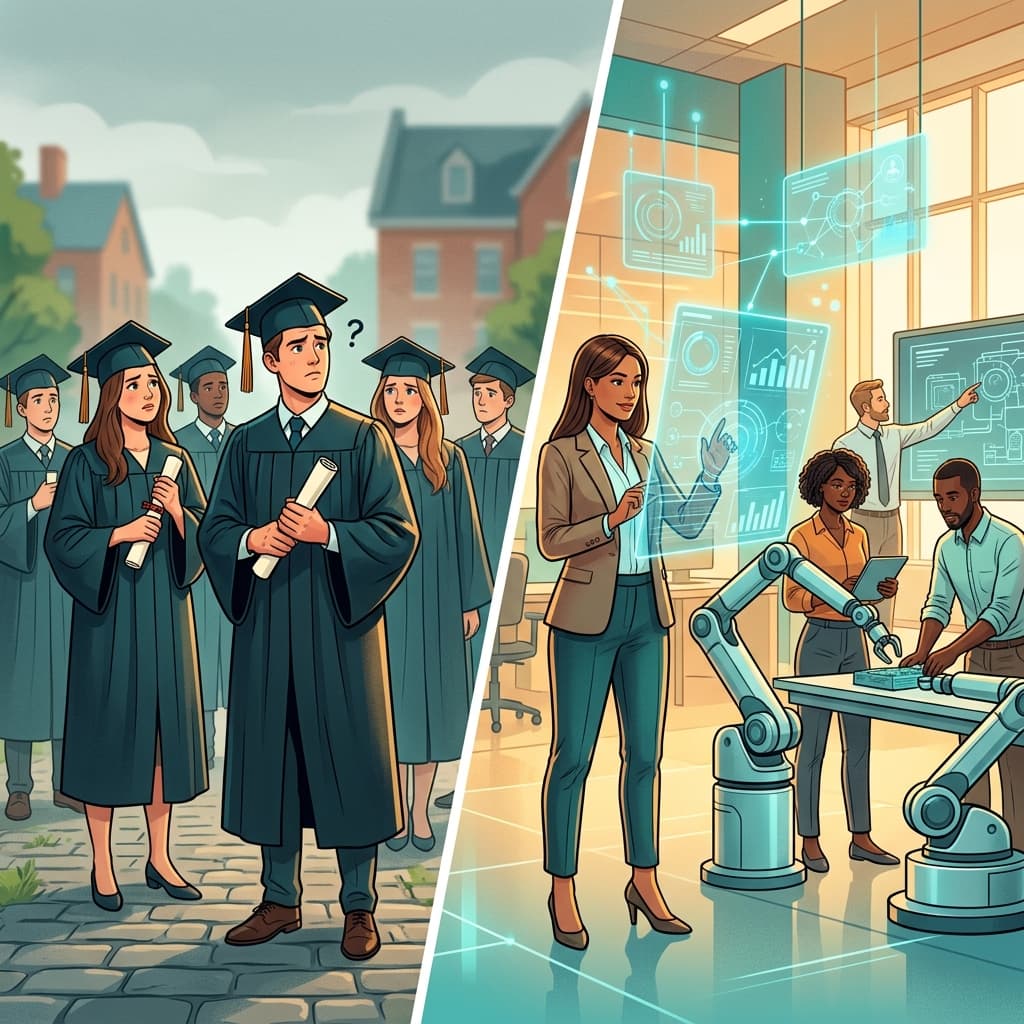
Universities Aren't Shrinking. They're Pivoting.
Perhaps the most important part of the story isn't what disappeared. It's what replaced it.
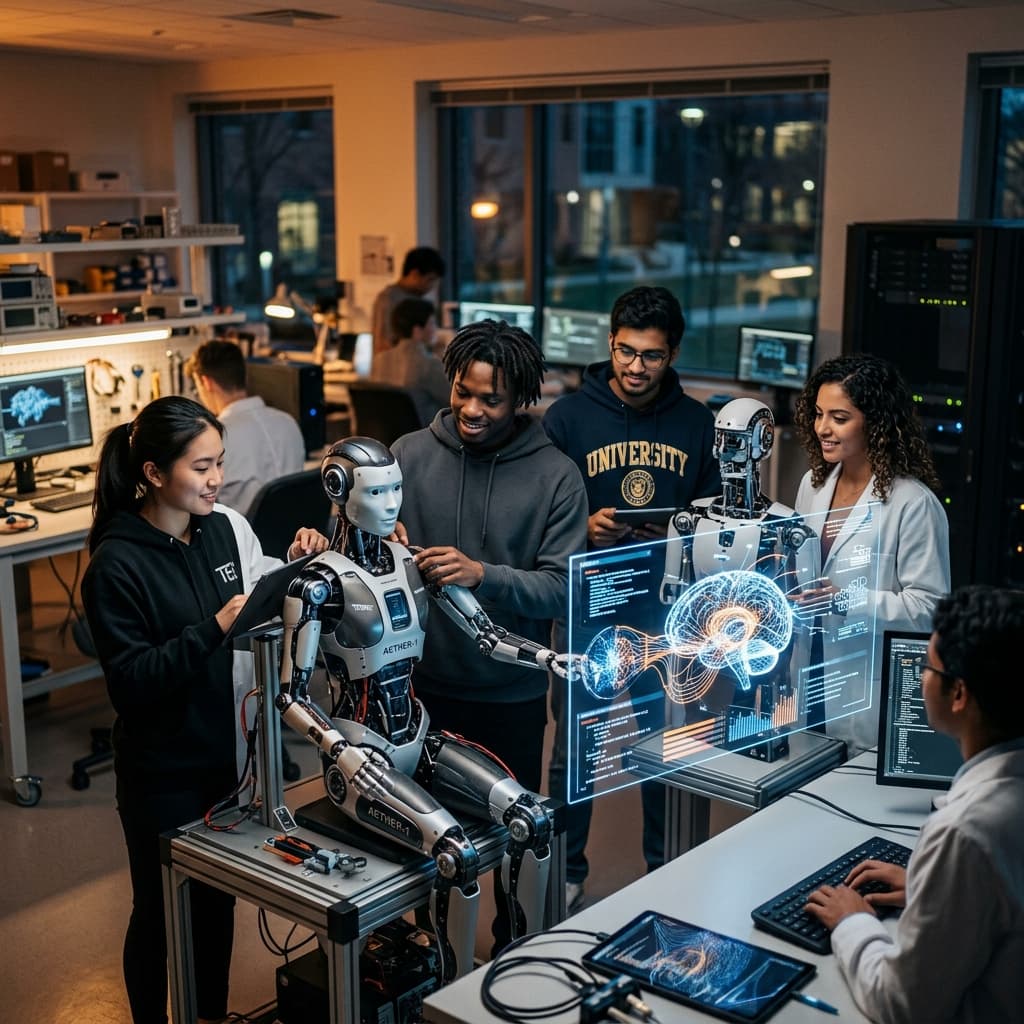
Leading institutions — including Shanghai Jiao Tong University, Zhejiang University, and Beijing Institute of Technology — have introduced programmes focused on Embodied Intelligence: the intersection of artificial intelligence and robotics.
According to Beijing Institute of Technology, industry currently faces a shortage of roughly one million professionals in embodied intelligence. Government projections estimate the sector could reach:
- 400 billion yuan by 2030
- Over 1 trillion yuan by 2035
This isn't simply curriculum reform. It's workforce planning — universities being aligned with long-term industrial strategy rather than historical academic structures.
The Real Lesson Isn't About China
It's tempting to see this as another uniquely Chinese policy story. That would be a mistake. China simply has the ability to move faster — and at a larger scale — than most education systems. The underlying trend is global.
Australia. Canada. The UK. Germany. The United States. Every higher education system will eventually confront the same question. The only difference is timing.
Students Need to Ask Better Questions
For years, choosing a degree meant asking: Which subject interests me? Which university has the best reputation? Which degree has traditionally led to good employment?
Those questions still matter. But they're no longer enough. The better question today is:
What parts of this profession can't AI easily replace?
Consider translation. A programme focused entirely on sentence-level translation is increasingly vulnerable. A programme that develops legal interpretation, negotiation, intercultural communication, and multilingual advisory skills is much harder to automate.
The same applies to design. Learning to manually create assets is becoming less valuable. Learning to solve business problems, lead creative strategy, understand users, and direct AI tools is becoming significantly more valuable.
The Future Belongs to AI-Enhanced Professionals
One misconception continues to dominate conversations about AI: that it's replacing entire professions. In reality, AI is replacing tasks — not necessarily careers. The professionals who thrive will be those who combine technical knowledge with skills AI struggles to replicate:
- Critical thinking & complex decision-making
- Leadership & human communication
- Creativity & ethical judgement
- Cross-cultural understanding
Universities that redesign around these capabilities will produce graduates with lasting value. Those that continue teaching yesterday's workflows risk leaving students behind.
Final Thought
China's decision to eliminate 12,200 degree programmes is not a warning against studying arts, languages, or management. It's a warning against studying any programme that hasn't evolved with the future of work.
For students and families planning higher education — whether in China, Australia, Canada, Germany or the UK — the goal shouldn't be to chase the newest trend. It should be to choose programmes that teach what AI can enhance, not what AI can replace.
Because in the age of artificial intelligence, the safest degree is no longer the most prestigious one. It's the one designed for the world that's actually coming.
The figures cited in this article are based on China's Ministry of Education data, with reporting from Xinhua and the South China Morning Post.
Start Your Journey
Ready to choose the right programme?
Our certified counsellors help you pick programmes aligned with the future of work — in Australia, Canada, the UK, USA, Germany and beyond.